
mathematics
mathematicsartificial intelligenceapplied mathematics+2 more
Applied mathematics has met the machine before
The long version of my guest essay for Proofs and Prompts, published there on 28 September 2026.
47 min read
Read more
Featured

Tag
18 posts
The long version of my guest essay for Proofs and Prompts, published there on 28 September 2026.

Interim guidance sent to the postgraduate students of our College on using AI tools in coursework, research and the thesis, written in the week of the Navier–Stokes announcement.
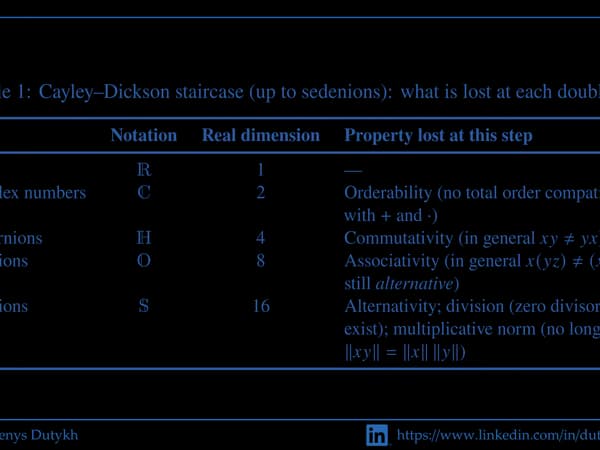
The Cayley–Dickson staircase is usually presented as far as the octonions. One step further, at the sedenions of real dimension 16, alternativity, division and the multiplicative norm all fall at once.
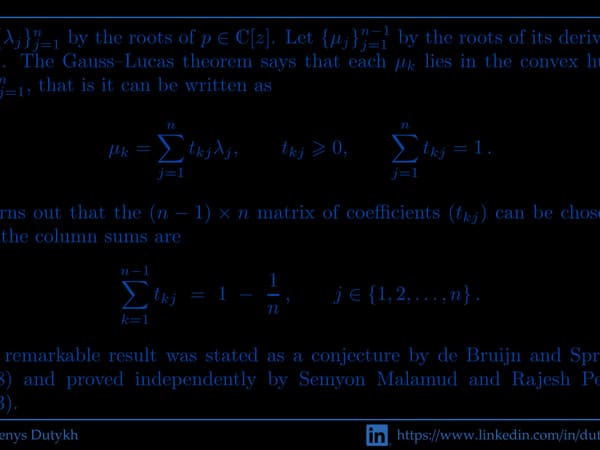
Gauss–Lucas puts the roots of the derivative inside the convex hull of the roots. De Bruijn and Springer conjectured in 1948 that they are pulled inward on average — it took 55 years and two proofs.
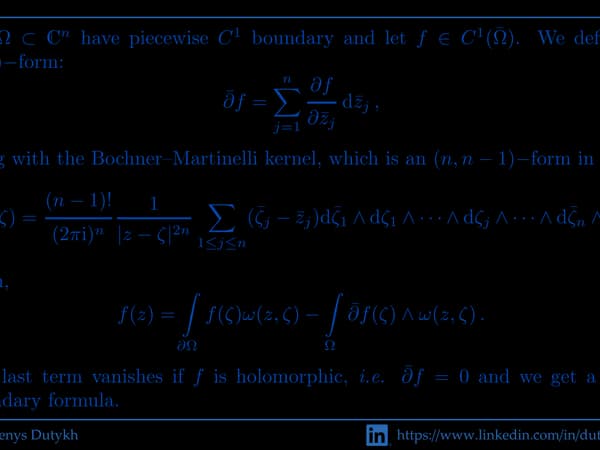
Closing the cycle on the Cauchy integral formula: Bochner–Martinelli recovers a function from its boundary data, up to a term measuring the failure of holomorphicity, with one universal kernel.

In several complex variables there is no translation-invariant holomorphic kernel. The Cauchy–Leray–Fantappiè formula answers this by building its kernel from a defining function of the boundary.

What survives of the Cauchy integral formula when the function is no longer analytical? A smooth version exists, and a single volume term measures exactly how far holomorphicity fails.

How do big gaps in power series relate to Stein manifolds? A look at the Hadamard Gap Theorem and why the unit disk is a Stein manifold.

A concise look at the complex analytic version of the Implicit Function Theorem (IFT), focusing on the case of two complex variables and its generalization.

A brief introduction to Stein manifolds, their equivalent definitions, and the intuition behind domains of holomorphy in several complex variables.

Why can’t we generalize conformal mappings to higher dimensions? Explore Poincaré’s theorem, which launched the study of several complex variables as a field of its own.

A playful look at the inconsistent and misleading names in mathematics, and how terminology can confuse even the experts. Share your favorites in the comments!

A fresh look at the trace of a square matrix: its linearity, role in the dual space of operators, unique tensor characterization, and its connection to inner products and the transpose via the dual.

How far can the classical Lipschitz condition for uniqueness in ODEs be relaxed? Discover Osgood’s theorem and its historical context in the theory of ordinary differential equations.

Explore the Cauchy-Lipschitz (Picard-Lindelöf) theorem for implicit ordinary differential equations, which establishes rigorous conditions for existence and uniqueness of solutions in the general case.

Explore Gevrey classes, a powerful framework for understanding the growth of power series coefficients, with insights from Edmond Maillet's theorem on formal solutions to analytical differential equations.

Explore the elegant Submersion Theorem, a cornerstone of differential geometry that reveals the intricate relationship between smooth maps and manifold structures in mathematical analysis.

Discover the elegant, coordinate-free definition of differential operator symbols through a homological perspective, revealing deep connections in mathematical analysis.