
The Cayley–Dickson Staircase: What Each Doubling Costs
The Cayley–Dickson staircase is usually presented as far as the octonions. One step further, at the sedenions of real dimension 16, alternativity, division and the multiplicative norm all fall at once.
The main result
Dear Reader, in today's brief we discuss the number systems of mathematics, and how doubling the dimension quietly fades out the laws we take for granted. The construction is the Cayley–Dickson staircase, and it is relatively famous — but in the literature it is usually presented only as far as the octonions. There is no reason to stop there.
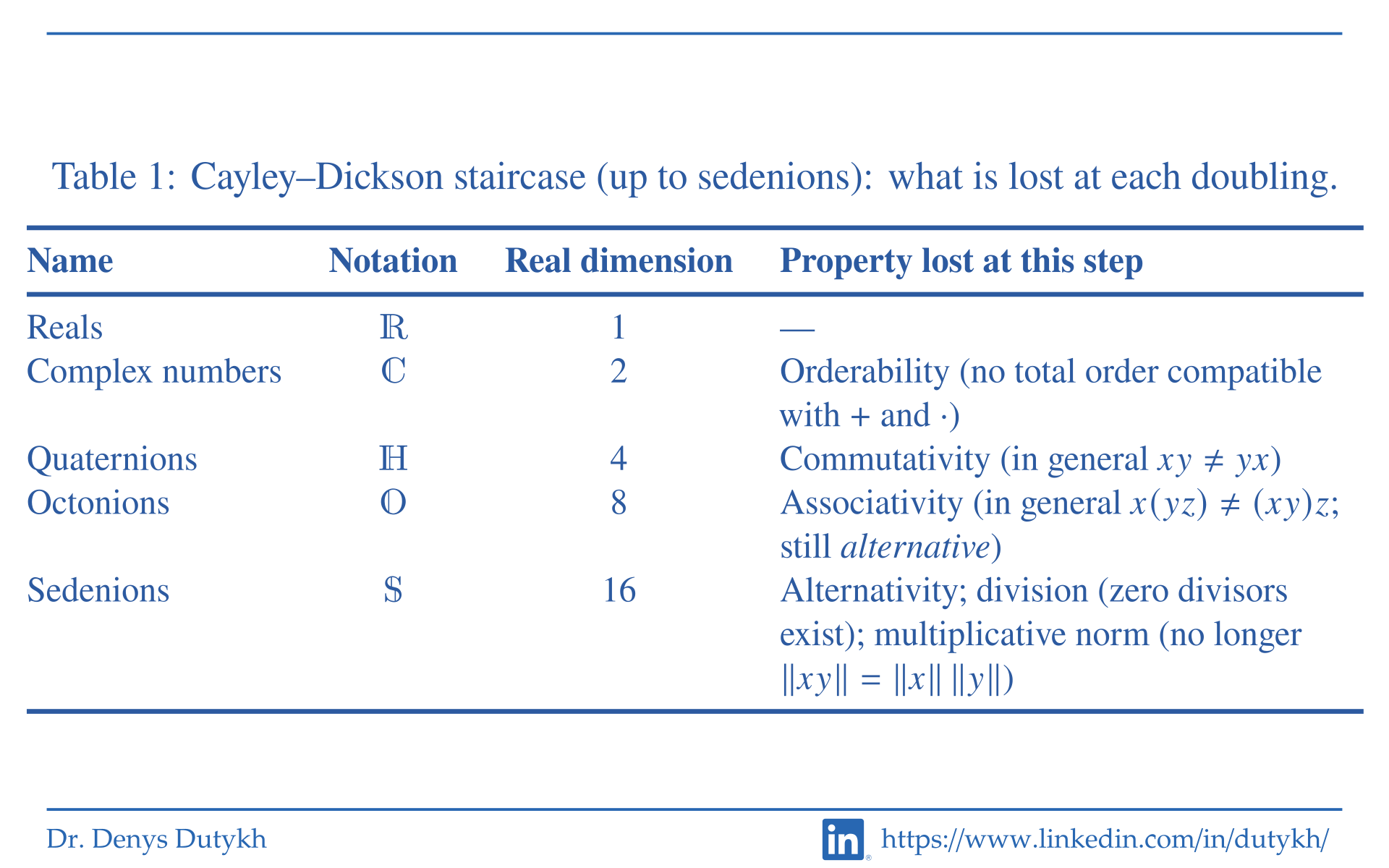
So we take one step further, up to the sedenions of real dimension 16. The point of the exercise is what it costs. At every doubling some familiar property is surrendered: on passing to we lose orderability, to commutativity, to associativity — though the octonions remain alternative, which is a consolation. And the stakes become higher at each level: at alternativity, division and the multiplicative norm all go at once, so that fails and zero divisors appear.
The trade-offs are summarised in the table below. Please enjoy it without moderation.
Dr. Denys Dutykh
Associate Professor of Mathematics
Khalifa University of Science and Technology, Abu Dhabi, UAE
Related Posts

Applied mathematics has met the machine before
The long version of my guest essay for Proofs and Prompts, published there on 28 September 2026.

Interim Guidance on the Use of AI Tools in Postgraduate Studies and Research
Interim guidance sent to the postgraduate students of our College on using AI tools in coursework, research and the thesis, written in the week of the Navier–Stokes announcement.
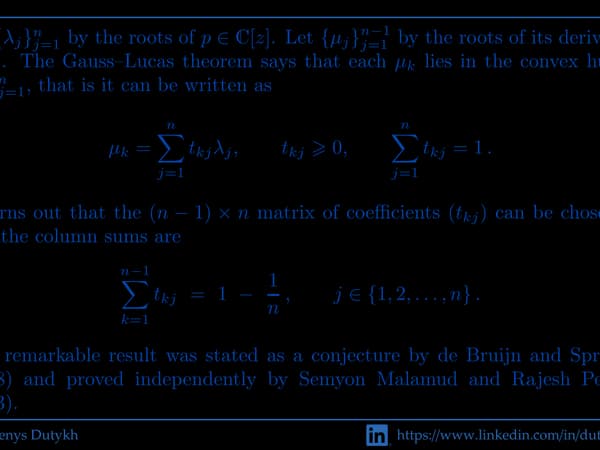
From Gauss–Lucas to de Bruijn–Springer
Gauss–Lucas puts the roots of the derivative inside the convex hull of the roots. De Bruijn and Springer conjectured in 1948 that they are pulled inward on average — it took 55 years and two proofs.