
From Gauss–Lucas to de Bruijn–Springer
Gauss–Lucas puts the roots of the derivative inside the convex hull of the roots. De Bruijn and Springer conjectured in 1948 that they are pulled inward on average — it took 55 years and two proofs.
The main result
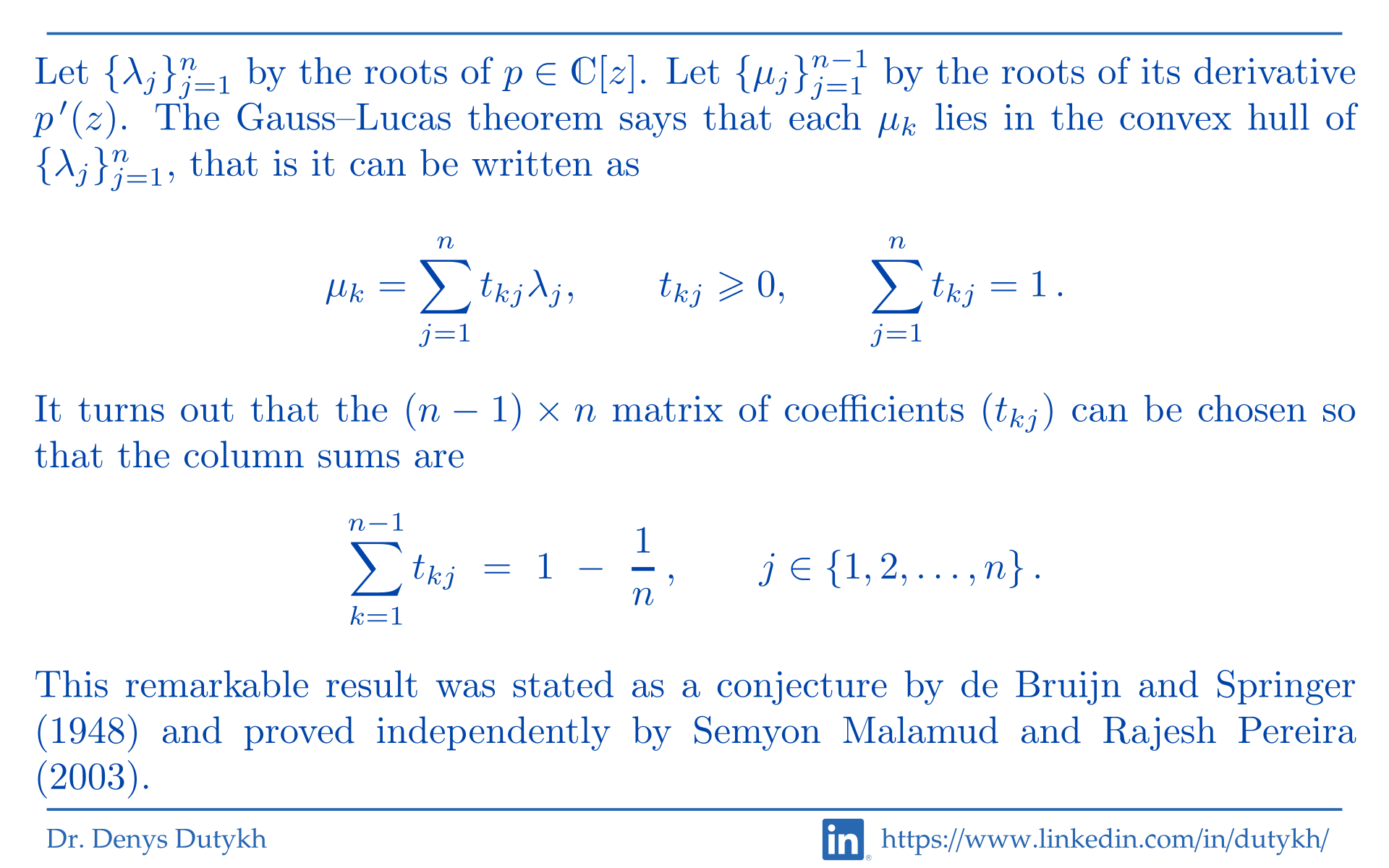
Dear Reader, in today's brief we leap from Gauss–Lucas to de Bruijn–Springer. For decades mathematicians chased a clean link between the roots of a polynomial and those of its derivative. Gauss–Lucas gives the first half of it: every root of sits inside the convex hull of the roots of , so each one can be written as a convex combination of them — the rows of the weight matrix sum to one.
The de Bruijn–Springer conjecture of 1948 went further. The roots of the derivative are not merely inside the hull, they are pulled inward on average, and the slide below says in what sense. The matrix of convex weights can be chosen so that its columns sum to as well. Every root of then carries exactly the same total weight, and the consequence is a majorisation: for every convex function, the average over the critical points does not exceed the average over the roots.
The conjecture stayed open for 55 years. Then, in 2003, Semyon Malamud and Rajesh Pereira independently cracked it, each with a short and elegant argument. Why do breakthroughs so often arrive in pairs? Please enjoy this beautiful result below.
Dr. Denys Dutykh
Associate Professor of Mathematics
Khalifa University of Science and Technology, Abu Dhabi, UAE
Related Posts
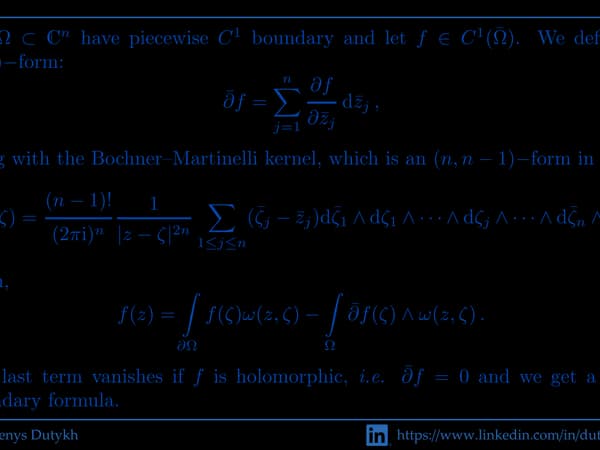
The Bochner–Martinelli Formula
Closing the cycle on the Cauchy integral formula: Bochner–Martinelli recovers a function from its boundary data, up to a term measuring the failure of holomorphicity, with one universal kernel.

The Cauchy–Leray–Fantappiè Formula in Several Variables
In several complex variables there is no translation-invariant holomorphic kernel. The Cauchy–Leray–Fantappiè formula answers this by building its kernel from a defining function of the boundary.

The Cauchy Integral Formula Beyond Analyticity
What survives of the Cauchy integral formula when the function is no longer analytical? A smooth version exists, and a single volume term measures exactly how far holomorphicity fails.