
The Cauchy–Leray–Fantappiè Formula in Several Variables
In several complex variables there is no translation-invariant holomorphic kernel. The Cauchy–Leray–Fantappiè formula answers this by building its kernel from a defining function of the boundary.
The main result
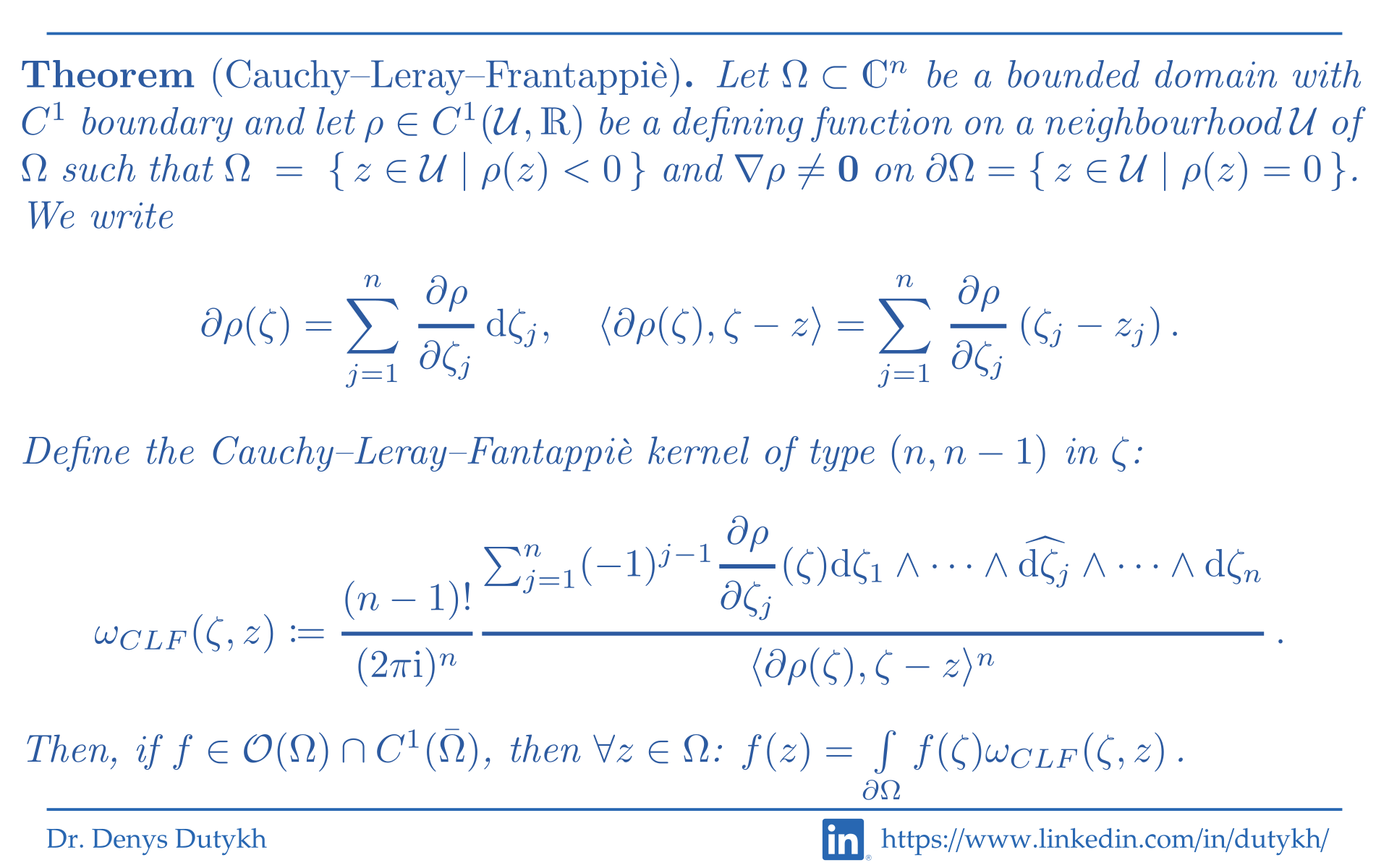
Dear Reader, in the previous brief we discussed the difference between the analytical and the smooth versions of the celebrated Cauchy integral formula. Today I propose to touch upon its multi-dimensional counterpart. For the sake of clarity, we begin with the version for holomorphic functions.
The obstacle one encounters in several dimensions is the absence of translation-invariant holomorphic kernels: nothing plays on its own the role that plays in the plane. What is used instead are domain-adapted analytic kernels, built from a defining function of the boundary. The Cauchy–Leray–Fantappiè kernel is exactly of that kind — it is assembled from , so it knows about the domain rather than only about the difference .
See the sequel on the slide below.
Dr. Denys Dutykh
Associate Professor of Mathematics
Khalifa University of Science and Technology, Abu Dhabi, UAE
Related Posts
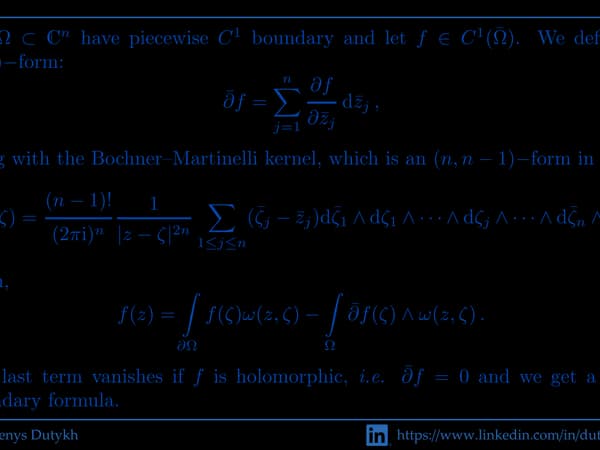
The Bochner–Martinelli Formula
Closing the cycle on the Cauchy integral formula: Bochner–Martinelli recovers a function from its boundary data, up to a term measuring the failure of holomorphicity, with one universal kernel.

From Gauss–Lucas to de Bruijn–Springer
Gauss–Lucas puts the roots of the derivative inside the convex hull of the roots. De Bruijn and Springer conjectured in 1948 that they are pulled inward on average — it took 55 years and two proofs.

The Cauchy Integral Formula Beyond Analyticity
What survives of the Cauchy integral formula when the function is no longer analytical? A smooth version exists, and a single volume term measures exactly how far holomorphicity fails.