
The Cauchy Integral Formula Beyond Analyticity
What survives of the Cauchy integral formula when the function is no longer analytical? A smooth version exists, and a single volume term measures exactly how far holomorphicity fails.
The main result
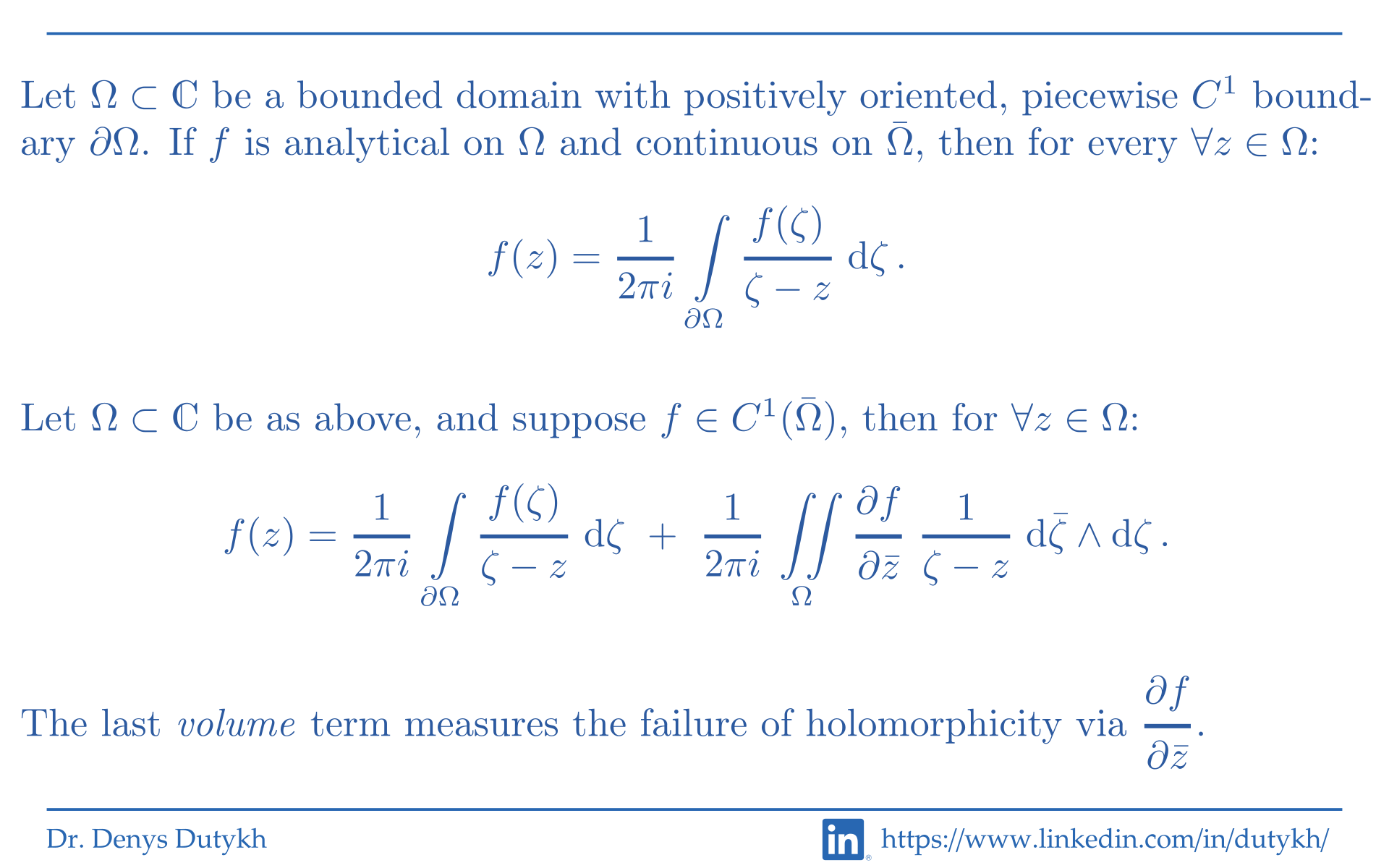
Dear Reader, I can finally return to my briefs in mathematics. Today I would like to revisit a thoroughly classical topic: the Cauchy integral formula, which belongs to the programme of any respectable university. The interesting question is what becomes of it once the function is no longer analytical.
There is a smooth version of the formula, and the hypothesis it needs is remarkably modest — smoothness suffices, in contrast to full analyticity. The classical statement reappears in it unchanged, joined by a single volume term built from . That term is the whole story: on a holomorphic function it vanishes, and in general it measures precisely how far the function fails to be holomorphic.
It can be found in books such as the celebrated Principles of Algebraic Geometry by Griffiths and Harris. Both statements are below, side by side.
Dr. Denys Dutykh
Associate Professor of Mathematics
Khalifa University of Science and Technology, Abu Dhabi, UAE
Related Posts
The Bochner–Martinelli Formula
Closing the cycle on the Cauchy integral formula: Bochner–Martinelli recovers a function from its boundary data, up to a term measuring the failure of holomorphicity, with one universal kernel.
From Gauss–Lucas to de Bruijn–Springer
Gauss–Lucas puts the roots of the derivative inside the convex hull of the roots. De Bruijn and Springer conjectured in 1948 that they are pulled inward on average — it took 55 years and two proofs.

The Cauchy–Leray–Fantappiè Formula in Several Variables
In several complex variables there is no translation-invariant holomorphic kernel. The Cauchy–Leray–Fantappiè formula answers this by building its kernel from a defining function of the boundary.