
The Hadamard Gap Theorem and Stein Manifolds
How do big gaps in power series relate to Stein manifolds? A look at the Hadamard Gap Theorem and why the unit disk is a Stein manifold.
The main result
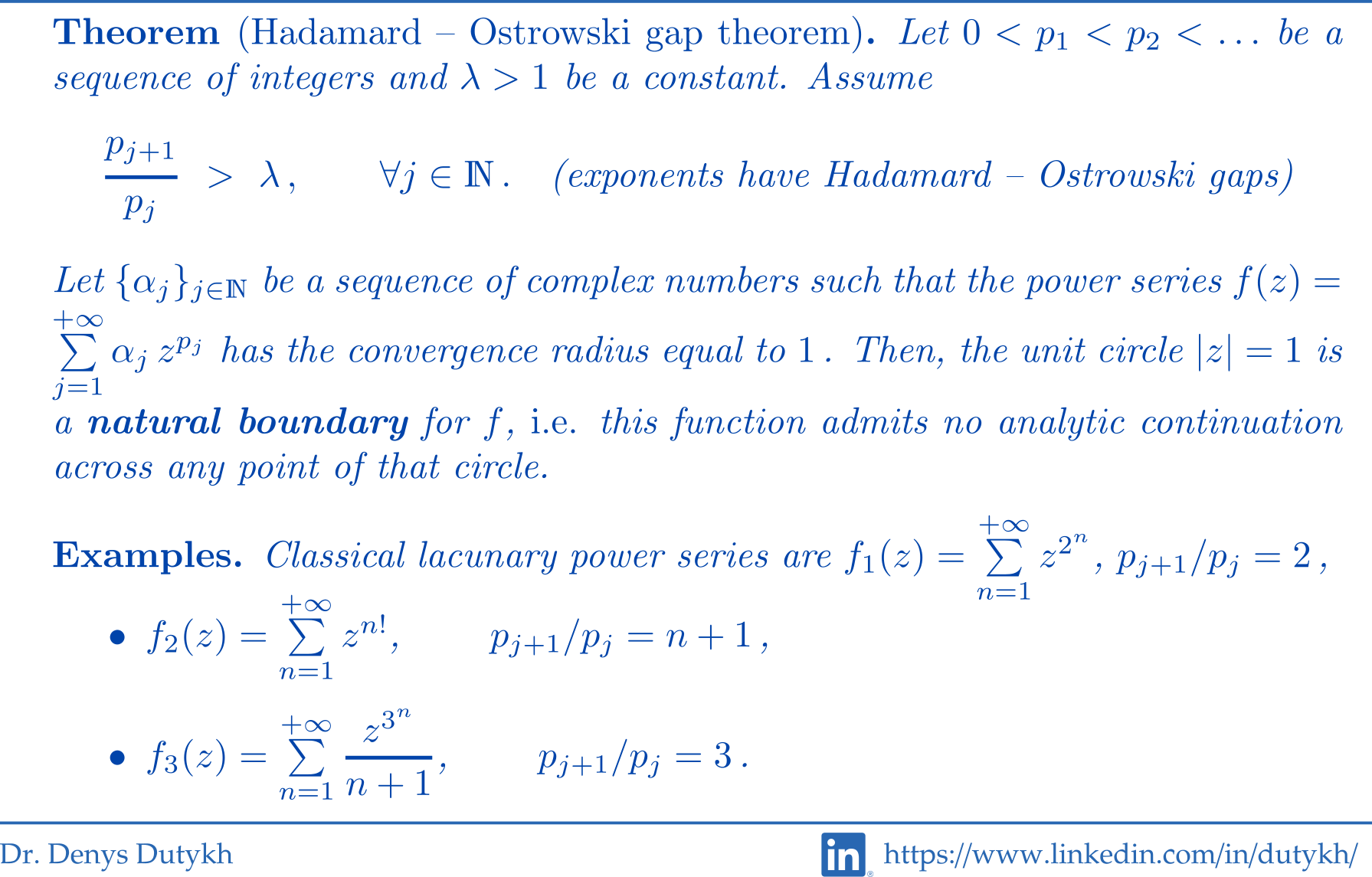
Dear Reader, today's brief is a follow-up post on the topic of Stein manifolds that I mentioned some time ago. Basically, the Theorem we highlight today is probably the most straightforward way to see that the unit open disk is a Stein manifold. However, the real question is why this result holds. Informally speaking, we can say that big gaps imply that near the boundary, the series behaves almost like a single monomial term. The problem is that monomials of unbounded degree tend to oscillate too violently near the boundary, which prevents any possibility of analytic continuation.
Dr. Denys Dutykh
Associate Professor of Mathematics
Khalifa University of Science and Technology, Abu Dhabi, UAE
Related Posts
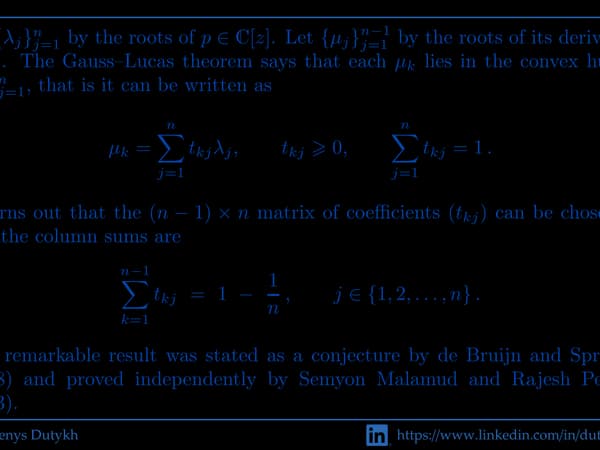
From Gauss–Lucas to de Bruijn–Springer
Gauss–Lucas puts the roots of the derivative inside the convex hull of the roots. De Bruijn and Springer conjectured in 1948 that they are pulled inward on average — it took 55 years and two proofs.
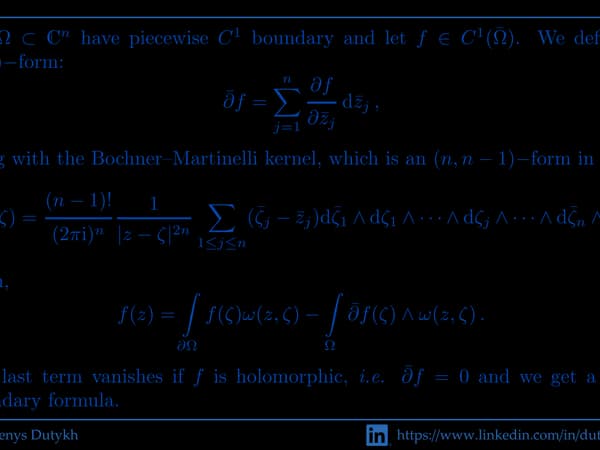
The Bochner–Martinelli Formula
Closing the cycle on the Cauchy integral formula: Bochner–Martinelli recovers a function from its boundary data, up to a term measuring the failure of holomorphicity, with one universal kernel.

The Cauchy–Leray–Fantappiè Formula in Several Variables
In several complex variables there is no translation-invariant holomorphic kernel. The Cauchy–Leray–Fantappiè formula answers this by building its kernel from a defining function of the boundary.