
Poincaré’s Theorem: The Ball vs. The Polydisc in Several Complex Variables
Why can’t we generalize conformal mappings to higher dimensions? Explore Poincaré’s theorem, which launched the study of several complex variables as a field of its own.
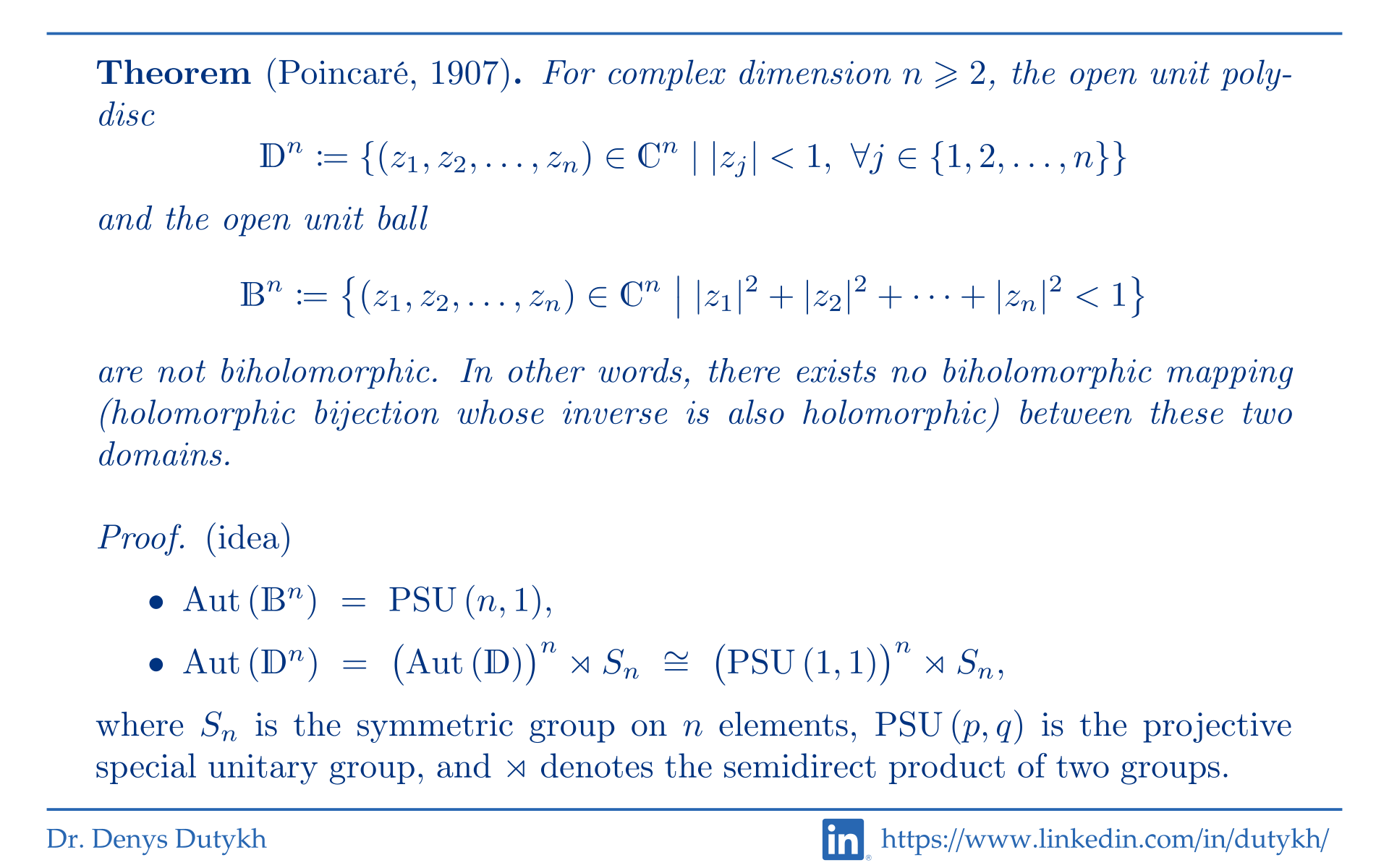
The main result
Dear Reader, in today's brief, I would like to discuss a less widely known Theorem by Henri Poincaré. Informally speaking, it tells us that the generalisation of conformal mappings to higher (complex) dimensions is not straightforward at all. This theorem initiated the study of functions of multiple complex variables as an independent discipline in the beginning of the XXst century. Poincaré proved it in the case of two complex variables, but I will give it in a more general case. The idea of the proof consists of computing the group of automorphisms of each domain. Since they turn out to be quite different, the conclusion is obvious. Please enjoy this beautiful result.
Dr. Denys Dutykh
Associate Professor of Mathematics
Khalifa University of Science and Technology, Abu Dhabi, UAE
Related Posts

From Gauss–Lucas to de Bruijn–Springer
Gauss–Lucas puts the roots of the derivative inside the convex hull of the roots. De Bruijn and Springer conjectured in 1948 that they are pulled inward on average — it took 55 years and two proofs.
The Bochner–Martinelli Formula
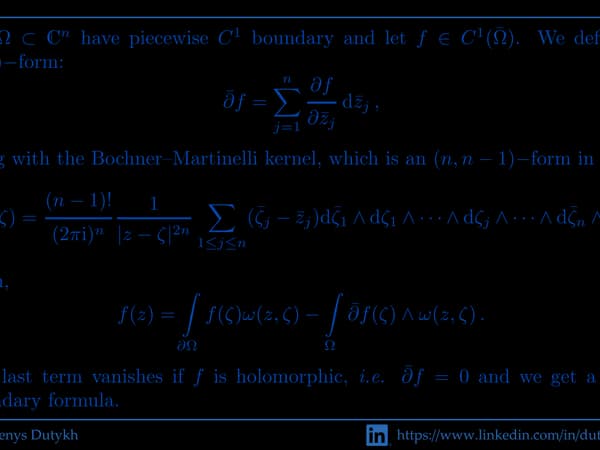
Closing the cycle on the Cauchy integral formula: Bochner–Martinelli recovers a function from its boundary data, up to a term measuring the failure of holomorphicity, with one universal kernel.

The Cauchy–Leray–Fantappiè Formula in Several Variables
In several complex variables there is no translation-invariant holomorphic kernel. The Cauchy–Leray–Fantappiè formula answers this by building its kernel from a defining function of the boundary.