
The Submersion Theorem: Unveiling the Geometry of Manifold Mappings
Explore the elegant Submersion Theorem, a cornerstone of differential geometry that reveals the intricate relationship between smooth maps and manifold structures in mathematical analysis.
The main result
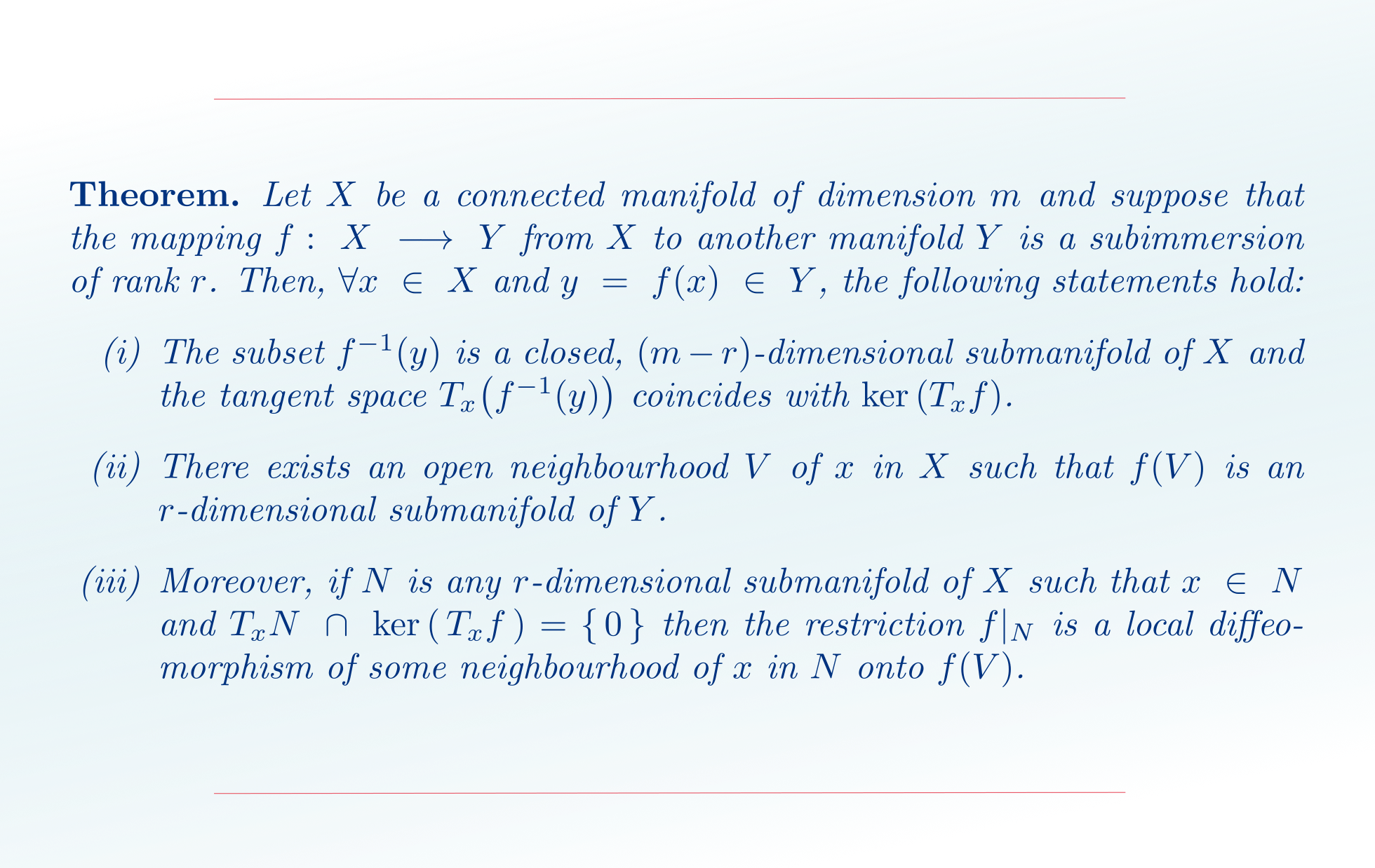
Dear Reader, in today's brief, I am pleased to highlight the Subimmersion Theorem, an essential result in differential geometry that enables the construction of new manifolds from existing ones. This theorem is fundamental in various mathematical analyses, particularly in manifold theory and geometry. A detailed and rigorous proof can be found in Jean Dieudonné's celebrated work, Éléments d'Analyse (Volume III). The formal statement of the theorem is provided below for your enjoyment and reflection without moderation:
Dr. Denys Dutykh
Associate Professor of Mathematics
Khalifa University of Science and Technology, Abu Dhabi, UAE
Related Posts

Applied mathematics has met the machine before
The long version of my guest essay for Proofs and Prompts, published there on 28 September 2026.

Interim Guidance on the Use of AI Tools in Postgraduate Studies and Research
Interim guidance sent to the postgraduate students of our College on using AI tools in coursework, research and the thesis, written in the week of the Navier–Stokes announcement.
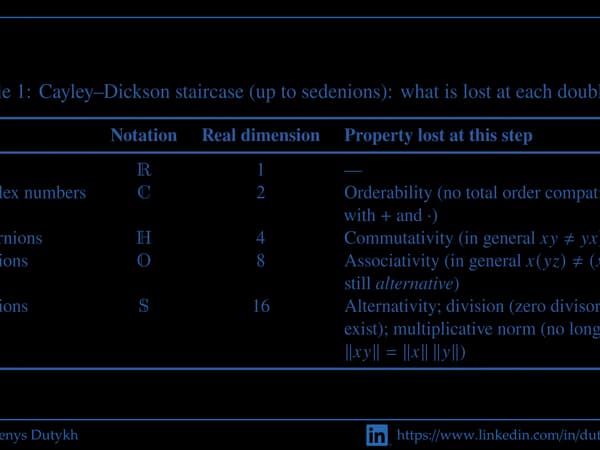
The Cayley–Dickson Staircase: What Each Doubling Costs
The Cayley–Dickson staircase is usually presented as far as the octonions. One step further, at the sedenions of real dimension 16, alternativity, division and the multiplicative norm all fall at once.