
The Complex Analytic Implicit Function Theorem: A Brief Revisit
A concise look at the complex analytic version of the Implicit Function Theorem (IFT), focusing on the case of two complex variables and its generalization.
The main result
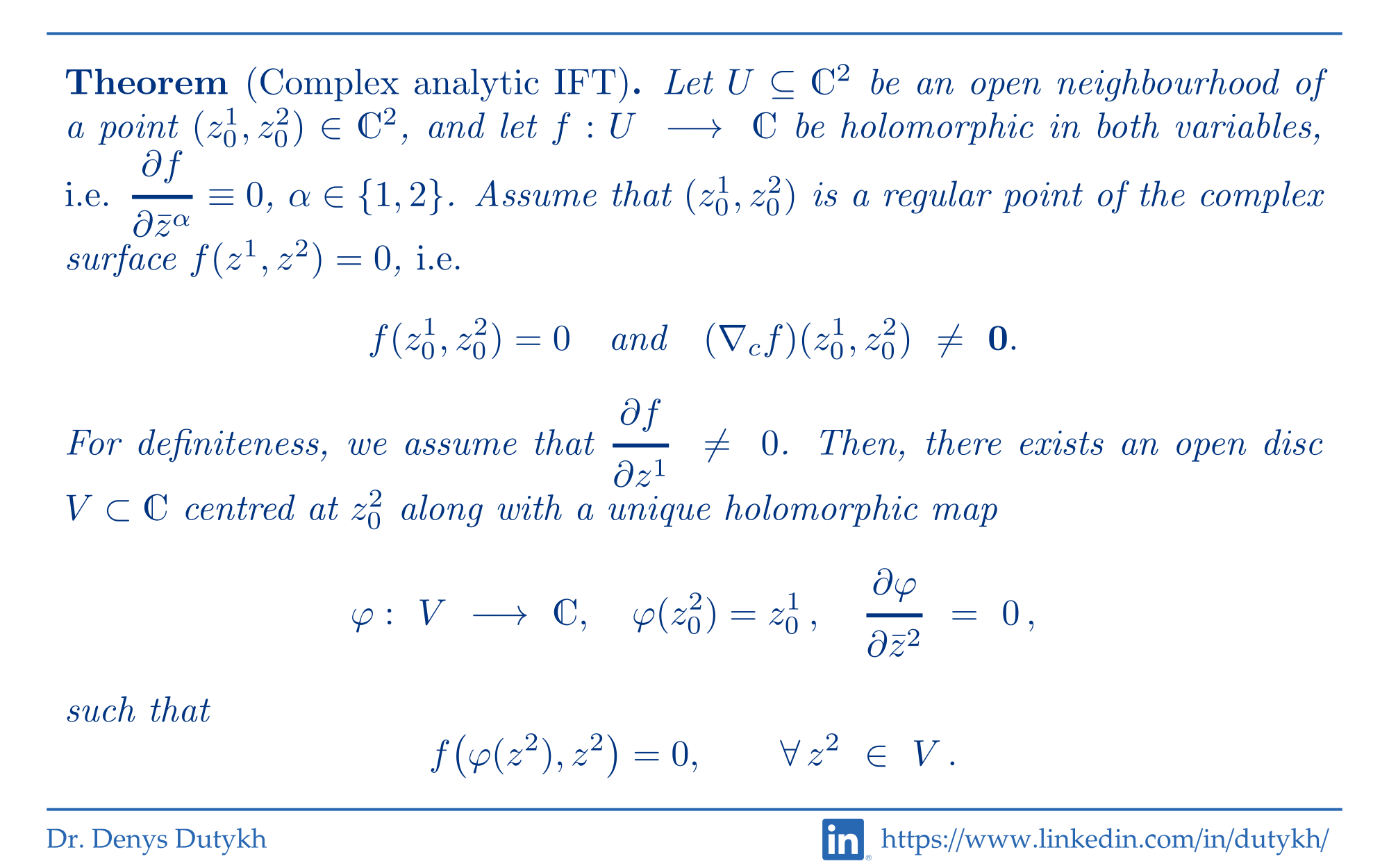
Dear Readers, after a short break due to the student examination period at Khalifa University, I am happy to return to the mathematical briefs format that I initiated some time ago. In today's brief, let us remind ourselves of the complex analytic version of the celebrated Implicit Function Theorem (IFT), whose importance in analysis is difficult to overestimate. For the sake of simplicity, let us consider the case of two complex variables only. It can be easily generalised to any finite number of variables if necessary.
Dr. Denys Dutykh
Associate Professor of Mathematics
Khalifa University of Science and Technology, Abu Dhabi, UAE
Related Posts

From Gauss–Lucas to de Bruijn–Springer
Gauss–Lucas puts the roots of the derivative inside the convex hull of the roots. De Bruijn and Springer conjectured in 1948 that they are pulled inward on average — it took 55 years and two proofs.
The Bochner–Martinelli Formula
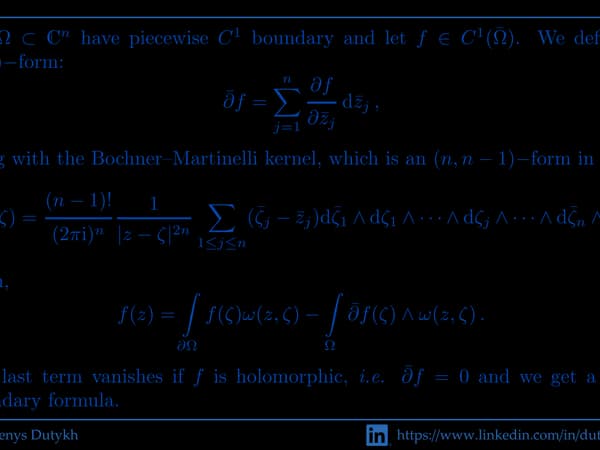
Closing the cycle on the Cauchy integral formula: Bochner–Martinelli recovers a function from its boundary data, up to a term measuring the failure of holomorphicity, with one universal kernel.

The Cauchy–Leray–Fantappiè Formula in Several Variables
In several complex variables there is no translation-invariant holomorphic kernel. The Cauchy–Leray–Fantappiè formula answers this by building its kernel from a defining function of the boundary.